logo
Aperçu

Le blog À propos New Fluorescence Tech Enhances Industrial Cooling Efficiency

Certificat
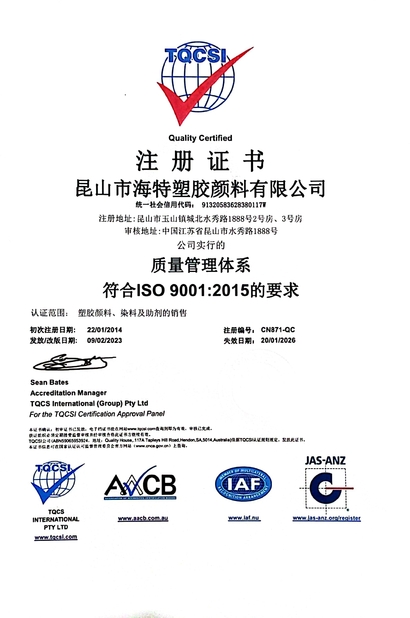
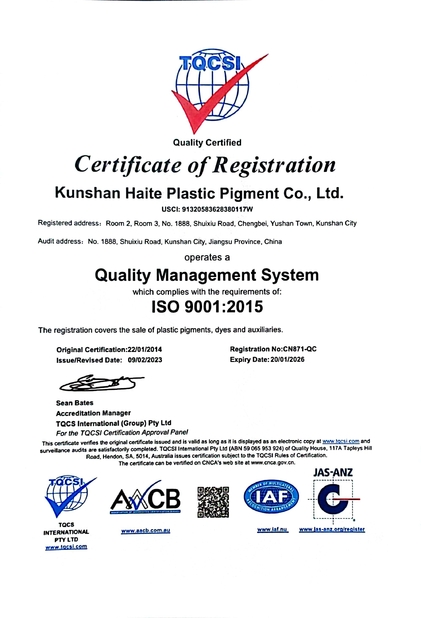
LA CHINE Kunshan Haite Plastic Pigment Co.,Ltd certifications
Examens de client
Nous examinons l'échantillon jaune et vérifions sa stabilité, et elle s'avère être meilleure trop. Il convient à notre encre de barre de mise en valeur. Pour ce colorant fluorescent d'encre, nous envisageons d'acheter un groupe.

—— Hossein

Nous employons le traceur fluorescent de PTSA comme traceur dans des circuits de refroidissement ainsi que nos produits chimiques de traitement de l'eau pour surveiller des changements d'équilibre d'eau. Cet échantillon est approuvé par notre technicien.

—— Parc

J'ai envoyé un iquiry et reçois le plus bientôt la réponse. Alors nous avons parlé par le téléphone de WhatsApp agréablement. L'ordre est sur la procédure.

—— Jose

Nous allons fabriquer des barres de mise en valeur et exiger de 5 couleurs de teindre pour le stylo de barre de mise en valeur. Après communication par l'approbation de téléphone et d'échantillon, nous avons une condition spécifique au sujet du vert dissolvant 7.

—— Motiwala

En raison du lockdown, nous avons juste commencé à consommer le dernier matériel en lots. Nous publierons le nouvel ordre une fois que nous avons besoin de lui. En juin, l'espoir everthing est meilleur et vient comme formel.

—— Kim

Nous avons des affaires agréables avec Kunshan Haite. Pour le premier ordre d'achat, nous avons examiné les échantillons après receving les et son résultat était mesure en hausse. Ce produit peut être employé comme agent de traitement de l'eau dans notre système en ligne de nuage, nous apporte ainsi plus d'efficacité. Il est la deuxieme fois que nous avons acheté de eux. Comptez coopérer au long terme.

—— Eram

Nous voudrions employer le vert dissolvant 7 à l'utilisation d'imprimantes à jet d'encre de Continuse dans l'industrie pour imprimer l'échéance et fabriquer la date. Elle peut être soluble en encre.

—— Zain

La série du bleu dissolvant 36 que j'ai achetés de Kunshan Haite est le mois dernier vraiment disponible pour nous. Elle n'influence pas la propriété chimique originale de notre produit. Elle a vraiment le grand resisitance de la chaleur. J'attends les colorants à solvant d'ordre d'autres couleurs après pour plus de conditions des clients.

—— Tam

Je suis un fabricant de l'antifreezer des voitures en Amérique. J'ai besoin d'un genre de colorant soluble dans l'eau comme agent de traceur. Quand j'ai vu le vert dissolvant 7 de Haite. J'ai contacté le commerçant d'exportation, et finalement nous avons conclu un accord. Performances des échantillons les “sont vraiment bonnes et disponibles pour nous.

—— KEN

Je suis en ligne une discussion en ligne
Entreprise Le blog
New Fluorescence Tech Enhances Industrial Cooling Efficiency
Dernières nouvelles de l'entreprise New Fluorescence Tech Enhances Industrial Cooling Efficiency

Chapter 1: The "Invisible Pain Points" and Management Challenges of Industrial Water Treatment

In modern industrial production, recirculating cooling water systems are often described as the "circulatory system" of manufacturing facilities. However, cooling water treatment has long operated as a "black box" management system. Maintenance personnel face extensive pipe networks, complex heat exchangers, and constantly changing makeup water quality.

Traditional management models typically rely on either "manual sampling + offline analysis" or "flow-proportional chemical dosing." These approaches suffer from three critical flaws:

  • Latency: Offline analysis creates delays of several hours or even days between sampling and results, leaving systems vulnerable to sudden water quality fluctuations.
  • Blind Operation: Flow-proportional dosing assumes ideal system conditions, ignoring variables like blowdown fluctuations, evaporation losses, and natural chemical degradation.
  • Cost Inefficiency: To mitigate scaling risks, operators often over-dose chemicals, leading to inflated costs and potential environmental contamination from excess treatment chemicals.

Chapter 2: PTSA – The "Digital Eye" for Cooling Water Treatment

PTSA (1,3,6,8-pyrenetetrasulfonic acid tetrasodium salt) serves as a molecular-level tracer with one defining characteristic: complete chemical inertness. It participates in no chemical reactions, resists bacterial degradation, and remains unaffected by oxidizing biocides. Functioning as a a "digital probe" within the system, it accurately reflects chemical retention levels as it circulates with the water flow.

Technical Characteristics of PTSA:

  • Exceptional Sensitivity: PTSA can be detected at parts-per-billion (ppb) concentrations, enabling comprehensive system monitoring with minimal additive quantities.
  • Unique Fluorescence Signature: Under specific wavelength excitation, PTSA emits distinctive fluorescence that remains virtually interference-free from common water impurities, ensuring data integrity.

Chapter 3: From Experience-Based to Closed-Loop Control Systems

To maximize PTSA's potential requires implementing a complete closed-loop control architecture:

  1. Smart Sensing Layer: Solid-state fluorescence sensors with self-cleaning capabilities continuously monitor fluorescence intensity in water samples.
  2. Data Analysis Layer: Controllers convert fluorescence signals into precise chemical concentration values, comparing them against predefined target concentration curves.
  3. Execution Control Layer: When concentrations fall below thresholds, controllers automatically activate chemical feed pumps, switching to maintenance mode when optimal levels are achieved. This "real-time response" approach achieves dosing accuracy exceeding 95%.

Chapter 4: Implementation Considerations and Practical Challenges

Despite PTSA's technological maturity, industrial applications require attention to several critical factors:

  • Biocide Interference Mitigation: Certain quaternary ammonium biocides exhibit fluorescence quenching effects. During their application, systems should switch to "time-lock mode," resuming fluorescence monitoring only after complete dispersion.
  • Turbidity and Color Compensation: In high-turbidity systems, suspended solids scatter excitation light. Instruments must incorporate "dual-wavelength compensation" technology to subtract background interference.
  • Storage and Preparation Protocols: PTSA requires light-protected storage. Manufacturing processes must maintain strict temperature controls to prevent hydrolysis in alkaline conditions, ensuring tracer purity.

Chapter 5: Industry Trends – The Path Toward Smart Water Management

With global carbon neutrality initiatives advancing, industrial water conservation has become a critical ESG metric. PTSA technology represents more than cost reduction—it enables "demand-based dosing" as a sustainable manufacturing practice. Future integration with IoT platforms will facilitate cloud-based data analysis, offering comprehensive lifecycle optimization for water treatment systems.

Conclusion: In an industrial environment rife with variables, PTSA introduces measurable certainty to cooling water treatment. By transforming complex chemical management into quantifiable data streams, it liberates maintenance teams from routine testing burdens, redirecting focus toward system optimization. This advancement represents not merely technological progress, but a fundamental shift in industrial water treatment philosophy.

Temps de bar : 2026-10-08 00:00:00 >> Blog list
Coordonnées
Kunshan Haite Plastic Pigment Co.,Ltd

Personne à contacter: Ms. Chai

Téléphone: 18001549185

Télécopieur: 86-0512-5779-6655

Envoyez votre demande directement à nous (0 / 3000)